The line between ITAM & ITSM has never been blurrier — or more consequential. Walk into any enterprise IT war room, and you’ll hear both terms tossed around as if they’re interchangeable. They aren’t. Confusing the two costs organizations real money: uncaught license compliance gaps, sluggish incident resolution, and asset blind spots that ripple across procurement, security, and operations.
In 2026, with hybrid work solidifying its grip, SaaS portfolios ballooning beyond 200 applications per organization, and regulatory scrutiny tightening, the ITAM vs ITSM debate isn’t academic. It dictates whether your helpdesk knows a laptop is still under warranty before dispatching a replacement. It determines if a critical audit reveals $1.2M in unused software — or a compliance exposure you never saw coming.
This article unpacks the core differences between IT asset management and IT service management, explains how each discipline drives specific business outcomes, and maps out exactly how they converge to create IT operations that are fast, compliant, and cost-intelligent. We’ll go beyond definitions to give you a pragmatic framework for deciding what your organization needs — ITAM, ITSM, or a thoughtfully integrated combination of both.
What Is ITAM (IT Asset Management)?
IT Asset Management (ITAM) is the structured practice of tracking, managing, and optimizing every technology asset an organization owns or subscribes to — from the moment it enters the environment until it’s retired. This spans hardware (laptops, servers, network gear, mobile devices, IoT endpoints) and software (on-prem licenses, SaaS subscriptions, cloud instances, containers). The goal is absolute visibility and financial control.
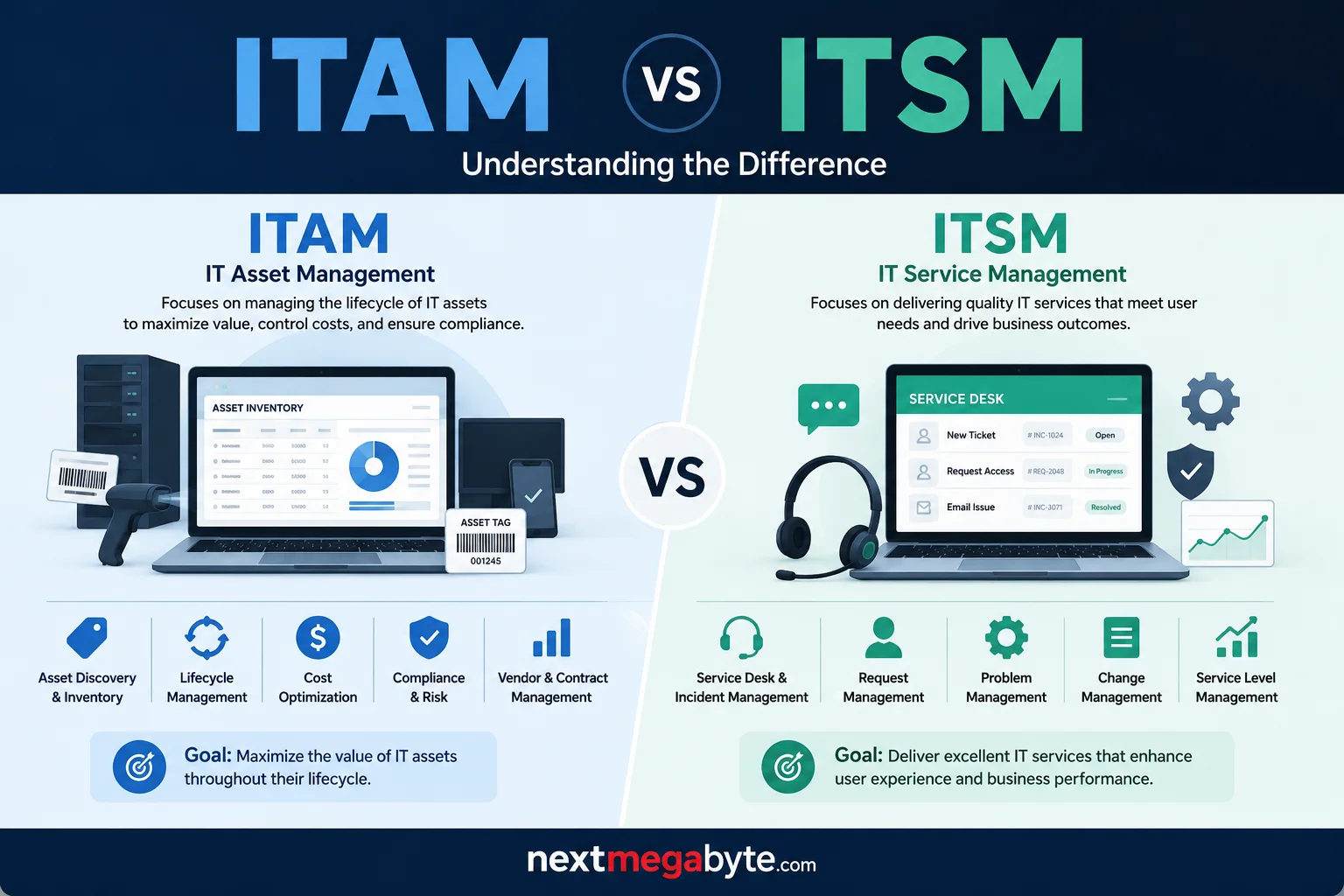
ITAM is the process of tracking and managing IT assets across their full lifecycle to improve visibility, compliance, and cost control.
Within ITAM, the IT asset lifecycle management framework typically covers five key phases:
- Procurement & onboarding — acquiring assets through approved channels, capturing vendor, cost, and contractual data.
- Deployment & assignment — allocating devices and software to users, departments, or cost centers.
- Monitoring & optimization — continuously tracking usage, performance, license consumption, and under-utilized assets.
- Compliance & audit defense — maintaining an accurate inventory, reconciling entitlements, and proving license position during vendor audits.
- Retirement & disposal — securely decommissioning assets, reclaiming licenses, wiping data, and managing e-waste responsibly.
Modern ITAM software turns these manual, spreadsheet-laden processes into an automated, single-source-of-truth. It discovers on-network and remote assets, normalizes software recognition, flags license shortfalls or shelfware, and feeds clean data into procurement and finance tools. For organizations with a heavy software footprint, dedicated SAM (Software Asset Management) capabilities are a subset of ITAM that drill deep into license models, cloud metering, and vendor-specific compliance rules.
Why does this matter for business outcomes? Without ITAM, IT costs inflate rapidly. Enterprises that implement mature ITAM programs routinely uncover 10–30% savings on software and hardware spend in their first year — not by cutting corners, but by eliminating waste, avoiding true-ups, and negotiating renewals with precise usage data.
What Is ITSM (IT Service Management)?
IT Service Management (ITSM) is the discipline of designing, delivering, managing, and improving the way IT services are provided to the business. Unlike ITAM, which focuses on the things, ITSM focuses on the workflows, processes, and human interactions that keep employees productive and systems reliable.
Most ITSM frameworks align with ITIL best practices and center on a core set of processes:
- Incident Management — restoring normal service operation as quickly as possible after a disruption.
- Problem Management — identifying root causes of recurring incidents and preventing them.
- Change Management — controlling modifications to IT infrastructure with minimal risk.
- Request Fulfillment — handling standard service requests, from onboarding a new employee to granting application access.
- Service Desk Operations — providing a single point of contact for users to report issues and ask questions.
ITSM software platforms — think ServiceNow, Jira Service Management, and Freshservice — give IT teams a structured, measurable way to handle these workflows. They track tickets, enforce approvals, automate routing, and surface SLA performance. When ITAM asks “Where is this asset, and what does it cost?”, ITSM asks “How can we restore the service it underpins in under 15 minutes?”
For CIOs, the value of mature ITSM is unambiguous: it directly improves user satisfaction, reduces mean time to resolution (MTTR), and provides the process backbone for change governance. In regulated industries, ITSM’s audit trails are non-negotiable.
ITAM & ITSM — Core Differences
The simplest way to internalize the difference between ITAM and ITSM is to think of ITAM as managing the resources and ITSM as managing the interactions. Both are essential, but they solve fundamentally different problems and serve different stakeholders.
| Dimension | ITAM | ITSM |
|---|---|---|
| Focus | Asset lifecycle (hardware, software, subscriptions) | IT service delivery and support |
| Primary Goal | Visibility, compliance, and cost optimization | Service efficiency, user experience, and stability |
| Key Users | IT Operations, Finance, Procurement, SAM teams | Service Desk, Support Engineers, IT Managers |
| Core Processes | Discovery, inventory, tracking, license management | Incident, problem, change, and request management |
| Data Managed | Hardware/software assets, contracts, entitlements | Tickets, SLAs, workflows, service catalogs |
| Key Metrics | Total cost of ownership (TCO), license compliance %, utilization rate | MTTR, First Call Resolution (FCR), SLA adherence % |
| Business Outcome | Cost control, audit readiness, risk reduction | Faster support, higher user productivity |
ITAM focuses on managing technology assets, while ITSM focuses on delivering and supporting IT services. ITAM manages assets; ITSM manages workflows and support operations.
In practice, the separation is stark: a well-oiled ITSM function can get an employee back to work quickly when their laptop breaks, but only ITAM can tell you whether that device is still under warranty, which software it’s licensed for, and when it’s due for a lifecycle refresh. Ignoring either leaves a blind spot that costs money and degrades service.
How ITAM & ITSM Work Together
The most operationally mature organizations don’t choose between ITAM & ITSM — they integrate them. When an asset record is linked to service tickets, the service desk gains superpowers. Every incident, request, or change automatically inherits rich context: warranty status, installed software, lifecycle stage, and even historical issues tied to that exact asset.
Take a real-world example. An employee reports that their corporate laptop keeps blue-screening. With integrated ITAM and ITSM:
- The ITSM system logs the ticket, captures the symptom, and assigns a technician.
- The ITAM system immediately surfaces critical data: the device is still under a next-business-day warranty, its last OS update was two days ago, and it has a known RAM issue flagged in previous tickets.
- The technician, instead of spending 40 minutes diagnosing, instantly knows a warranty claim is in order, arranges a replacement, and closes the ticket 60% faster.
Without integration, the same incident becomes a multi-tool scramble: the helpdesk agent has no asset context, the user is asked for serial numbers, and warranty eligibility is discovered days later after manual lookup — if at all.
ITAM and ITSM integration delivers this context at scale. It automates workflows where asset data triggers service actions. For instance:
- A device reaching end-of-life automatically creates a change request for replacement.
- A software license nearing its install limit prevents new service requests from being fulfilled until procurement is alerted.
- A high-priority incident on a server automatically pulls configuration data from the CMDB, helping problem management identify the blast radius.
Platforms that natively unify asset and service data — such as nextmegabyte.com’s approach of building service desk intelligence on a live asset backbone — collapse the gap between “what do we own?” and “how do we support it?” The result isn’t just faster ticket resolution; it’s a closed-loop IT operation where every service action is informed by accurate, real-time asset truth.
Benefits of Integrating ITAM & ITSM
Integration moves IT from a cost center that reacts to a business partner that anticipates. Here’s what changes when you stop treating ITAM and ITSM as separate silos.
Faster Ticket Resolution
When service desk analysts can see a complete asset history — specs, warranty, past incidents, linked changes — right inside the ticket, they skip the discovery phase. Average handling time drops. First-contact resolution rises. Escalations decline because tier-1 teams are no longer flying blind.
Better Compliance & Audit Readiness
Software audits from vendors like Oracle, IBM, and Microsoft demand precise license positions. Integrated asset-to-service data proves that deployed software matches entitlements and that changes were authorized. If an auditor asks why a specific application was installed on 50 devices, the linked change records in your ITSM provide the answer instantly. Audit cycles compress from months to days.
Reduced IT Costs
Waste hides in the gaps. A laptop that sits in a drawer but remains active in ITSM as an assigned asset triggers unnecessary support costs and lost opportunities for reuse. Integrated systems automatically flag dormant assets, reconcile statuses, and prevent duplicative purchases. One enterprise client of nextmegabyte.com uncovered $340,000 in redundant SaaS licenses simply by aligning their ITSM request data with actual ITAM usage metrics.
Improved Asset Visibility
ITAM tools discover what’s connected. ITSM tools show what’s being used and complained about. Together, they paint a 360-degree picture: which models fail most often, which software versions generate the most tickets, and which configurations are truly stable. This intelligence feeds directly into hardware standards and vendor scorecards.
Smarter Procurement Decisions
Renewal negotiations become data-driven. Instead of guessing how many Adobe Creative Cloud licenses are “probably” needed, IT leaders can pull precise activation data from ITAM alongside request trends from ITSM. Procurement teams renew with confidence, right-sizing contracts and reallocating budget to strategic initiatives.
Keywords like centralized IT operations, IT workflow automation, and IT visibility aren’t just buzzwords here — they describe the tangible outcomes of weaving asset intelligence into every service touchpoint.
ITAM & ITSM Use Cases
Not every scenario demands both disciplines. Understanding the natural domain of each helps you assign ownership and avoid process overlap.
| Scenario | ITAM | ITSM |
|---|---|---|
| Tracking physical laptops | ✅ | ❌ |
| Handling a password reset ticket | ❌ | ✅ |
| Defending a Microsoft license audit | ✅ | ❌ |
| Managing a server outage | ❌ | ✅ |
| Approving a firewall change | ❌ | ✅ |
| Tracking asset depreciation | ✅ | ❌ |
| Onboarding a new employee | ✅ (provision) | ✅ (request & fulfill) |
| Analyzing software utilization | ✅ | ❌ |
| Root cause analysis of recurring crashes | ❌ (asset data informs) | ✅ (problem mgmt) |
Notice that the highest-value scenarios sit at the intersection. Employee onboarding, for instance, relies on ITSM to manage the request and fulfillment workflow, while ITAM ensures the right hardware and software are assigned, licensed, and accounted for from day one. When a device repair escalates, ITAM’s warranty data tells ITSM whether to fix or replace — and triggers a purchase request if needed.
Do You Need ITAM, ITSM, or Both?
The answer depends on organizational size, complexity, and risk profile, but a useful heuristic is this: if you own assets and provide services, you eventually need both.
- Small and midsize businesses (SMBs) often start with lightweight ITSM tools — something as simple as a shared mailbox evolves into a ticketing system. ITAM may be a spreadsheet. As SaaS sprawl and remote work expand, manual asset tracking breaks. By ~100 employees, the risk of a license audit or uncontrolled device lifecycle becomes material, making structured ITAM a necessity.
- Mid-market organizations (100–1,000 employees) typically run a dedicated ITSM platform and feel acute pain from disjointed asset data. At this stage, integrating ITAM shifts from “nice to have” to a force multiplier for the service desk. Procurement and finance also start demanding better cost data, pulling ITAM closer to core operations.
- Enterprises (1,000+ employees) live in regulated, multi-vendor, multi-site environments where both mature ITAM and ITSM are mandatory. Here, silos aren’t just inefficient — they’re dangerous. An unmanaged asset in a PCI- or HIPAA-scoped environment can trigger an audit failure. A change request without asset impact analysis can cause a critical outage. Unified platforms that bring ITAM and ITSM into a single operating model become a governance imperative.
Industries with heavy compliance burdens — financial services, healthcare, government, defense — lean on integrated ITAM-ITSM even more aggressively. Audit trails that span procurement, deployment, incident resolution, and disposal must be seamless and indisputable.
If your organization’s IT maturity is growing, consider sequencing: implement foundational ITSM processes first to stabilize service delivery, then layer in ITAM to inject asset intelligence. The quickest wins come when both are running against the same data set.
Best ITAM & ITSM Tools in 2026
The market offers everything from point solutions to full-stack platforms. Here’s a snapshot of the current landscape for ITAM software, ITSM software, and unified options.
| Platform | ITAM Capability | ITSM Capability | Best For |
|---|---|---|---|
| ServiceNow | Advanced | Advanced | Global enterprises with complex ITIL needs |
| Freshservice | Moderate | Strong | Mid-market teams that value ease of use |
| Jira Service Management | Limited | Strong | DevOps-centric and agile IT teams |
| ManageEngine | Strong | Strong | Mid-enterprise looking for broad IT management |
| nextmegabyte.com | Unified ITAM + ITSM | Integrated workflows | Enterprises seeking a single-platform approach |
Your selection depends on whether you need depth in one discipline or a platform that erases the boundary between asset and service. Organizations tired of sync jobs, middleware, and mismatched CMDBs increasingly lean toward unified architectures that treat ITAM and ITSM as two sides of the same coin.
Frequently Asked Questions (FAQ)
What is the difference between ITAM and ITSM?
ITAM manages IT assets (hardware, software, subscriptions) across their lifecycle, focusing on cost, compliance, and visibility. ITSM manages IT service delivery and support processes like incidents, changes, and requests. ITAM asks “what do we have?”; ITSM asks “how do we keep services running?”
Can ITAM exist without ITSM?
Yes, but it’s limited. You can track assets in isolation, but without ITSM integration, you miss critical service context — such as which assets are causing the most tickets or whether a failed device is under warranty when a user reports it.
Why integrate ITAM and ITSM?
Integration cuts ticket resolution time, automates asset-aware workflows, closes compliance gaps, and gives procurement real usage data. It turns the service desk from a reactive cost center into an intelligence-driven function.
Is ITAM part of ITIL?
ITIL 4 includes asset management as a practice within the Service Management framework. ITAM isn’t a separate pillar but is recognized as essential to service value — especially in the Service Configuration Management and IT Asset Management practices.
What are examples of ITSM tools?
Common ITSM platforms include ServiceNow, Jira Service Management, Freshservice, BMC Helix, and Zendesk. Many of these are expanding into lightweight ITAM or integrating with dedicated asset management solutions.
Which is more important: ITAM or ITSM?
Neither is inherently more important — they address different operational needs. ITSM directly impacts user productivity and service stability. ITAM directly impacts cost control and compliance. In most organizations above 200 employees, both are critical, and their integration delivers the highest ROI.
Does nextmegabyte.com provide both ITAM and ITSM?
Yes. nextmegabyte.com offers a unified cloud platform that combines full IT asset lifecycle management with integrated service desk and ITSM workflows, designed to give enterprises a single source of truth for assets and services.
Conclusion
ITAM & ITSM isn’t a contest – it’s a convergence. One without the other leaves organizations operating with one eye closed: either your services run fast but on bad asset data, or your asset records are pristine but your support workflows limp along without context. In 2026, that kind of operational debt is unacceptable.
ITAM manages the assets. ITSM manages the services. Together, they create a feedback loop where every incident informs asset strategy, and every asset detail accelerates service resolution. That’s how modern IT operations stop fighting fires and start building resilient, cost-efficient, and user-centric technology environments.
For enterprises ready to stop stitching together point tools and start running IT on a unified backbone, nextmegabyte.com delivers a centralized cloud platform that integrates IT asset management and IT service management — so your service desk always sees the full picture, your procurement always has accurate data, and your audits never come as a surprise. See how integrated IT operations can transform your service delivery and asset governance – explore the platform today.