
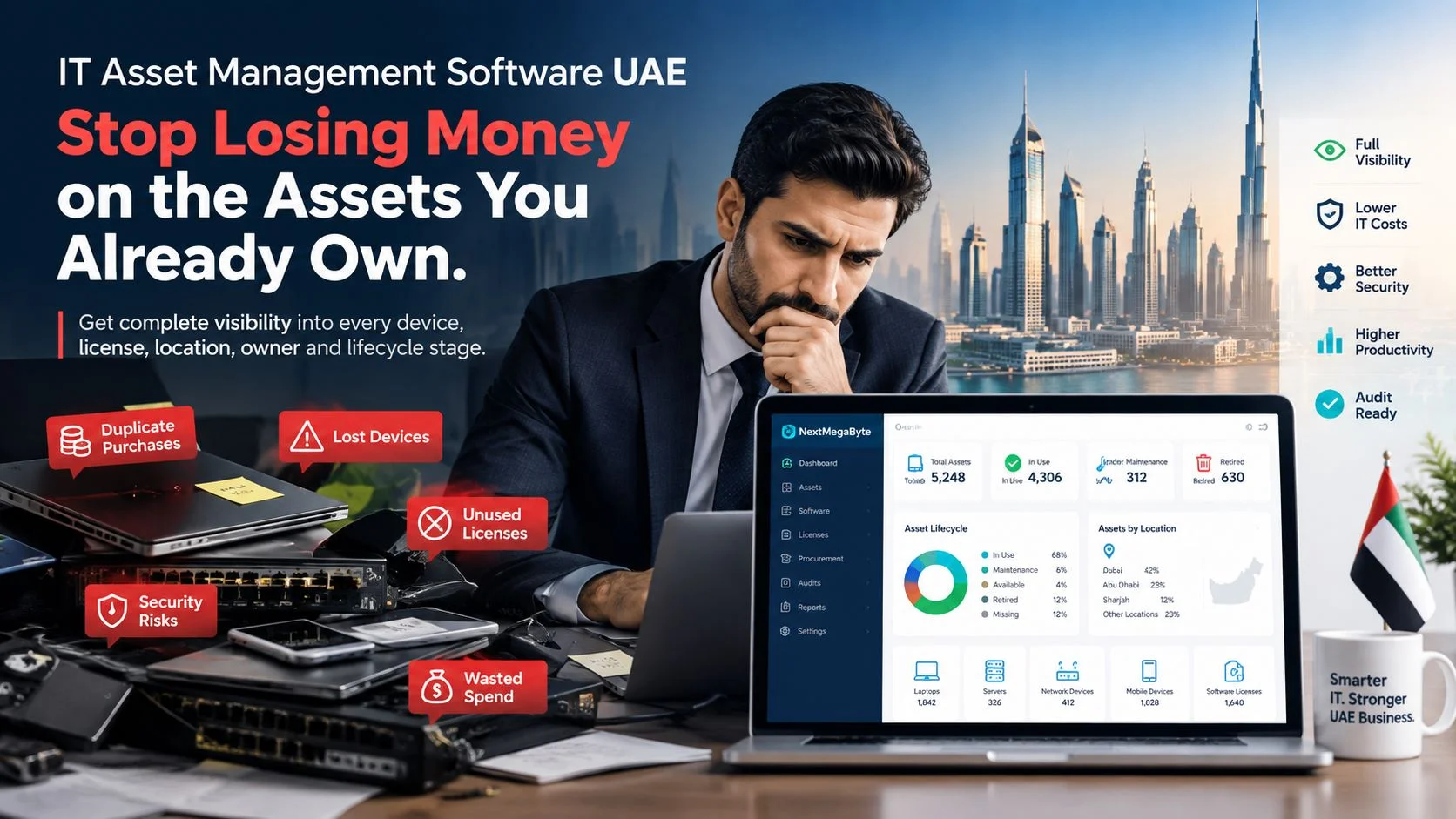
IT Asset Management Software UAE gives enterprises the visibility and control they need to manage laptops, desktops, servers, software licenses, network equipment, mobile devices, cloud subscriptions, and IT infrastructure without losing money through poor asset control.
So here is the uncomfortable question: do you know exactly where every asset is, who is using it, what it costs, whether it is still required, and what happens to it at the end of its lifecycle?
If the answer is “not completely,” your enterprise has an IT asset management problem — and in the UAE, that problem can extend beyond daily operations. Poor asset records can affect financial tracking, asset accountability, data protection, audits, and compliance requirements in regulated industries.
For businesses operating across Dubai, Abu Dhabi, Sharjah, multiple free zones, branches, and remote teams, spreadsheets and disconnected systems can create a serious visibility gap. That gap can lead to duplicate purchases, unused software licenses, missing devices, inaccurate asset records, inefficient audits, and unnecessary IT spending.
The real question is not whether your enterprise owns enough technology. It is whether you have complete control over the technology you already own.
why do UAE enterprises need IT asset management software uae?
IT asset management software gives an enterprise one centralized system to discover, track, assign, monitor, audit, maintain and retire IT assets across their full lifecycle. For UAE enterprises it does three things a spreadsheet cannot: it keeps a defensible fixed asset register for tax and audit purposes, it proves control of devices holding personal data under the UAE’s data protection law, and it maintains the asset inventory that UAE information assurance standards expect of regulated and government-linked entities.
The real cost of not having IT asset management software uae
Most enterprises calculate the cost of ITAM as the subscription price. That is the wrong calculation.
The better question is how much the business is already losing because its assets are not managed. Those losses rarely appear as a single line on a balance sheet. They show up as small, repeated leaks:
- A laptop is purchased while an identical device sits unused in a store room.
- A software license renews for an employee who left eight months ago.
- An employee exits the country and the assigned device is never recovered.
- Equipment moves from Dubai to Abu Dhabi and no record is updated.
- IT spends two hours locating an asset that should have been identifiable in seconds.
- The annual audit becomes a manual stock count across four locations.
- Retired equipment stays on the fixed asset register and keeps depreciating.
- Procurement approves purchases without accurate historical data.
- A security incident hits a device nobody can positively identify or attribute.
None of these is dramatic on its own. Together they are a permanent drag on IT budget and on the accuracy of your financial records.
Three UAE rules that turn your asset register into a compliance document
This is the section that separates a UAE article from a generic one. Most ITAM content sold into this market ignores it entirely.
1. The Federal Tax Authority expects your records to survive for years
Since corporate tax took effect in June 2023 under Federal Decree-Law No. 47 of 2022, the record-keeping bar has risen sharply. The Federal Tax Authority requires taxable persons to retain records and documents supporting their tax returns for at least seven years following the end of the relevant tax period. VAT records carry a five-year minimum, and capital asset records can run longer still depending on the asset type.
Your IT assets are capital assets. The purchase invoice, the depreciation schedule, the disposal record and the date an asset left the business are all part of that trail.
A spreadsheet maintained by whoever last held the IT coordinator role is not a defensible seven-year record. A system with an audit log, immutable purchase data and a dated disposal history is.
2. Retiring a laptop is a data protection event
Federal Decree-Law No. 45 of 2021, the UAE Personal Data Protection Law, sets obligations around securing personal data and maintaining its confidentiality. DIFC and ADGM entities sit under their own separate regimes — DIFC Data Protection Law No. 5 of 2020 and the ADGM Data Protection Regulations 2021.
Every laptop, phone and server you retire may hold personal data belonging to employees, customers or patients. If you cannot say which devices were wiped, when, by whom, and where they went afterwards, you cannot demonstrate that control.
An ITAM platform that records end-of-life status, data sanitization, and chain of custody turns disposal from an informal process into evidence.
3. Regulated entities are expected to maintain an asset inventory
The UAE Information Assurance Regulation, developed by the TDRA and originally issued by NESA, sets minimum controls for protecting information assets across designated entities. Asset management is one of its control domains, and it applies to government, semi-government and critical infrastructure organizations.
You cannot classify, protect or risk-assess an asset you have not inventoried. In practice, an accurate asset register is the precondition for almost every other control in the framework — and for ISO 27001 certification, which increasingly appears in UAE tender requirements.
The four hidden money leaks
Duplicate purchases
Without inventory visibility, departments buy equipment the business already owns. The fix is a sequence change, not a policy memo.
Instead of request → purchase → discover the spare later, the flow becomes request → check inventory → reuse, reassign or purchase.
In a multi-entity UAE group, this leak is larger than most finance teams assume, because each entity procures separately and nobody holds a consolidated view.
Unused software licenses
Software is the quietest place to lose money. A license keeps renewing when an employee leaves, when a role changes, when an application is decommissioned, when a device is retired, or when it was simply never used.
Software asset management gives you ownership, allocation, usage and renewal dates in one place. The objective is blunt: stop paying in AED for software nobody opens.
Lost and unaccounted devices
An enterprise laptop is not a AED 4,000 line item. It is hardware value plus the licenses installed on it, plus the data it can reach, plus the replacement cost, plus the security exposure if it goes missing unnoticed.
Assignment records, movement history and status tracking create accountability. Somebody’s name is against every device, and that record has a date on it.
Poor utilization
The most common problem is not losing assets. It is owning assets that nobody uses spare laptops in storage, duplicate infrastructure, inactive software, equipment kept “just in case” across four locations.
Buying more hardware does not solve a visibility problem. It makes the next audit harder.
The offboarding problem is sharper in the UAE than almost anywhere else
The UAE workforce is overwhelmingly expatriate, and turnover often means someone leaves the country rather than moving down the road. Once a departing employee has cleared immigration, a device they still hold is effectively unrecoverable.
That makes asset recovery a time-boxed process tied to final settlement and clearance, not a task IT gets to chase for a month.
The step that fails in most organizations is the second one. Nobody can produce a reliable list of what the leaver actually holds, so the clearance form gets signed on trust.
When HR offboarding is connected to an accurate asset register, the list generates itself and the device comes back before the visa is cancelled.
IT asset management software is more than tracking laptops
A modern ITAM platform is not an inventory database. It manages a chain where every stage creates cost, information and risk.
Most organizations manage the middle of that chain reasonably well and lose control at both ends — procurement data that never reaches the asset record, and disposals that are never formally closed. Those two gaps are where the tax and data protection exposure sits.
What UAE enterprises should be tracking
| Asset category | Examples | Why it matters locally |
|---|---|---|
| Computers | Laptops, desktops, workstations | Highest recovery risk at offboarding |
| Servers | Physical and virtual infrastructure | Capital asset records, data residency |
| Network devices | Switches, routers, access points | Multi-site branch consistency |
| Mobile devices | Smartphones and tablets | Personal data on devices that leave the country |
| Peripherals | Monitors, printers, docks, keyboards | Volume drives duplicate purchasing |
| Software | Applications and licenses | Renewals in AED and USD, unused seats |
| Data center equipment | Racks, UPS, storage | Depreciation and warranty tracking |
| Cloud resources | Subscriptions and services | Recurring spend outside procurement |
| Security devices | Firewalls, access control hardware | Information assurance control evidence |
| IoT equipment | Sensors, connected devices | Often unowned by any department |
| Non-IT assets | Furniture, vehicles, facility equipment | Frequently sits in the same register |
The goal is not to count assets. It is to know the ownership, location, status, cost and lifecycle stage of each one.
The capabilities to demand from ITAM software
If you are evaluating ITAM software in the UAE, do not settle for an asset register with a login screen.
Automated asset discovery
Your team should not hand-create every record. Network discovery builds and refreshes inventory continuously, which is the only way an estate above a few hundred devices stays accurate.
One centralized inventory
One asset, one record, one source of truth — covering details, assignment, department, location, purchase data, warranty, lifecycle status, maintenance, installed software and full history.
See how this works in practice on the enterprise asset management software platform.
Full lifecycle management
The platform should follow an asset from purchase order to disposal certificate. Assets that vanish from the process after deployment are exactly the ones missing at audit.
Barcode and RFID tracking
Above a few thousand assets, manual identification stops being viable. Tag-based scanning turns a three-week physical stock count into a walk-through with a handheld reader.
Explore RFID asset tracking software for automated physical verification.
Software asset management
Licenses owned, licenses assigned, expiry dates, actual usage, renewal exposure and unnecessary spend. Software should be a managed asset class, not an invoice that arrives annually.
Asset auditing
If the register says 5,000 assets, can your team physically verify them? A structured audit surfaces missing assets, wrong assignments, duplicate records, location mismatches, retired assets still listed and devices that were never registered at all.
Procurement integration
The lifecycle starts before the asset reaches an employee: requirement, approval, purchase, receiving, registration, assignment. Connecting these gives you the purchase evidence the FTA expects, attached to the asset it belongs to.
Learn more about IT procurement management software.
Service desk integration
When a ticket arrives for a faulty laptop, the agent should already see the device, its warranty status, its installed software and its incident history — not ask the user to read a serial number off the base.
Explore integrated IT service desk management.
ITAM and ITSM: stop running them separately
Your asset team and your service desk work on the same infrastructure. Keeping their data in separate systems means every incident starts with a research task.
A single asset accumulates incidents, service requests, changes, maintenance events, warranty claims, ownership changes, software installs and lifecycle milestones. Split across two systems, none of that history is usable.
The multi-emirate and free zone reality
A UAE enterprise rarely sits in one building. A typical estate runs across a Dubai head office, an Abu Dhabi branch, a Sharjah warehouse, one or more free zone entities and a set of remote employees.
Without a central system, each location invents its own method. One team keeps a spreadsheet, one relies on procurement emails, one maintains a local register, and one has nothing. Nobody holds the complete picture, and the group audit becomes a reconciliation exercise.
Free zone structures make this harder. DMCC, JAFZA, DIFC and ADGM entities are legally separate companies with their own books. Assets often need to be registered per entity while still rolling up to a single group view — and inter-entity transfers need a paper trail, because moving an asset between entities is a transaction, not a delivery.
A centralized platform with per-entity segregation and group-level reporting solves both at once. A spreadsheet solves neither.
ITAM versus Excel: the problem is not Excel
Excel stores asset information perfectly well. Storing information is not the same as controlling assets.
| Capability | Spreadsheet | ITAM platform |
|---|---|---|
| Record updates | Manual, by whoever remembers | Event-driven and logged |
| Asset movement | Overwritten, no history | Full movement trail |
| Audit | Manual count per location | Scan-based verification |
| Change history | None after a cell is edited | Dated audit log |
| License renewals | A reminder in someone’s calendar | Tracked with alerts |
| Multi-entity view | One file per entity | Segregated with group roll-up |
| Service desk link | None | Asset attached to every ticket |
| Tax evidence | Reconstructed at year end | Retained against each asset |
| Scaling | Breaks past a few hundred rows | Built for enterprise volume |
The real question is not whether Excel can track an asset. It is whether Excel can give a growing UAE enterprise a defensible record seven years from now, when someone asks where a specific server went and who signed off on wiping it.
How to choose IT asset management software in the UAE
Run every shortlisted vendor through this list. The last four questions are the ones generic global platforms tend to fail.
- Does it discover assets automatically across your network?
- Does it manage hardware and software in one register?
- Does it track ownership, assignment and movement with history?
- Does it handle multiple locations and multiple legal entities?
- Does it support barcode and RFID verification?
- Does it cover the full lifecycle through to disposal?
- Does it run structured audits, not just export a list?
- Does it integrate with procurement?
- Does it connect assets to service desk tickets?
- Does it manage licences, renewals and usage?
- Does it retain purchase and disposal evidence for the retention periods the FTA requires?
- Can it be hosted in the UAE if your records need to stay in-country?
- Does it support Arabic and AED where your teams and finance need it?
- Is there local implementation and support in the UAE, in your time zone?
If several answers are no, you are looking at an inventory tool, not an enterprise ITAM platform.
Why NextMegaByte for IT asset management in the UAE
NextMegaByte brings asset management and IT operations into one platform, so asset records, procurement, support, tracking and lifecycle data stop living in separate systems.
The platform covers IT and non-IT asset management, automated discovery, lifecycle management, barcode tracking, RFID integration, asset audits, software licence management, procurement, service desk, monitoring, patch management, enterprise reporting and multi-location visibility.
For organisations that want the operational load handled as well as the software, managed IT services extend asset management into day-to-day operations.
Your enterprise already owns the assets. Now control them.
You do not need more assets. You need to know what you have, where it is, who holds it, what it costs, whether it is used, whether it is secure, and when it should be retired.
Without those answers, asset costs stay hidden inside procurement, IT operations, support and finance — and the record you will need at your next audit does not exist yet.
Book a free NextMegaByte demo and see how centralised IT asset management gives your UAE enterprise control over its technology estate.
Book a free IT asset management demo
Frequently asked questions
What is IT asset management software in the UAE?
IT asset management software helps UAE organisations discover, track, assign, monitor, audit, maintain and retire IT assets from a single centralised system, and retain the purchase and disposal records that tax and audit requirements depend on.
Why do UAE enterprises need IT asset management software?
Enterprises with distributed IT estates need reliable visibility into ownership, location, lifecycle, software and utilisation. Without it, organisations overspend on duplicate hardware and unused licences, and cannot produce a defensible asset register when the FTA or an auditor asks for one.
How long must UAE businesses keep IT asset records?
Corporate tax records must generally be retained for at least seven years from the end of the relevant tax period, with a five-year minimum for VAT records and longer periods for certain capital assets. Since IT equipment is a capital asset, purchase invoices, depreciation data and disposal records fall inside these requirements. Confirm the current position with your tax advisor.
Does IT asset management help with UAE data protection compliance?
It supports it. Under the UAE Personal Data Protection Law, organisations must secure personal data, which includes data held on devices being retired. An ITAM platform that records sanitisation and disposal creates the evidence trail that demonstrates control.
Can ITAM software manage assets across multiple emirates and free zones?
Yes. Enterprise platforms maintain centralised visibility across Dubai, Abu Dhabi, Sharjah and other locations, and can segregate records by legal entity so free zone companies keep separate registers that still roll up to a group view.
Does IT asset management software support RFID?
Many enterprise platforms support RFID and barcode integration for physical identification, inventory verification, movement tracking and audit workflows — which is what makes large-estate audits practical.
Can ITAM integrate with an IT service desk?
Yes. Connecting asset records to service management attaches incidents, service requests and maintenance history to the specific asset involved.
What is the difference between ITAM and ITSM?
ITAM manages technology assets through their lifecycle. ITSM delivers and manages IT services. Running them together gives every ticket the full context of the asset behind it.
Can ITAM reduce IT spending?
It reduces waste rather than cost outright. Visibility into existing assets, licence allocation and utilisation lets organisations reuse equipment instead of buying it, cancel unused licences and avoid replacing assets still under warranty.