Most enterprises don’t have an IT asset management problem — they have a visibility problem. Hardware depreciates in forgotten storage rooms. Software licenses renew automatically on contracts nobody reviews. Cloud instances spin up and never spin down. Shadow IT proliferates across remote and hybrid workforces. And somewhere in that fog of untracked assets, security vulnerabilities quietly accumulate.
The financial and operational stakes are steep. According to Gartner, enterprises that systematically manage the lifecycle of their IT assets can reduce cost per asset by as much as 30 percent. Trend Micro research reveals that 74% of cybersecurity incidents involve unknown or unmanaged assets. And software non-compliance alone can trigger audit penalties exceeding $500,000 per incident. These are not edge-case risks — they are the predictable outcome of operating without a structured IT Asset Management (ITAM) strategy.
For CIOs and IT leaders heading into 2026, the question is no longer whether to implement ITAM — it’s how to do it in a way that delivers enterprise-wide impact from day one. The ITAM software market itself reflects this urgency, having grown from $4.66 billion in 2025 to $5.04 billion in 2026, with projections pointing to $6.78 billion by 2030.
This guide is a practical, phase-by-phase ITAM implementation roadmap designed specifically for enterprise IT teams who need more than theory — they need a framework they can act on.
What Is IT Asset Management? (ITAM Meaning & Definition)
Before diving into implementation, it’s worth anchoring on a precise definition — one that reflects where ITAM stands in 2026, not where it was five years ago.
IT Asset Management (ITAM) is the discipline of systematically tracking, governing, and optimizing an organization’s technology assets — including hardware, software, cloud resources, and SaaS subscriptions — across their full lifecycle, from procurement to retirement. The goal is to maximize asset value, reduce unnecessary spend, ensure license compliance, and minimize security and operational risk.
ITAM is no longer a back-office inventory exercise. In 2026, it functions as the single source of truth that feeds decision-making across IT operations, security, finance, procurement, and increasingly, ESG and sustainability reporting. When people ask “what is IT asset management,” the honest answer is that it has become a strategic control plane for the entire enterprise technology estate.
Why Enterprise ITAM Implementation Demands a Phased Roadmap
Many ITAM initiatives fail not because of technology, but because of scope ambiguity and organizational inertia. Enterprises attempt to boil the ocean — trying to track every asset across every environment simultaneously — and the project collapses under its own weight.
A phased roadmap solves this by breaking a complex, multi-year initiative into manageable, value-generating milestones. Each phase builds organizational maturity, improves data quality, and expands the scope of what ITAM governs. By the time you reach full-scale deployment, you’ve already demonstrated ROI — which secures continued investment and executive sponsorship.
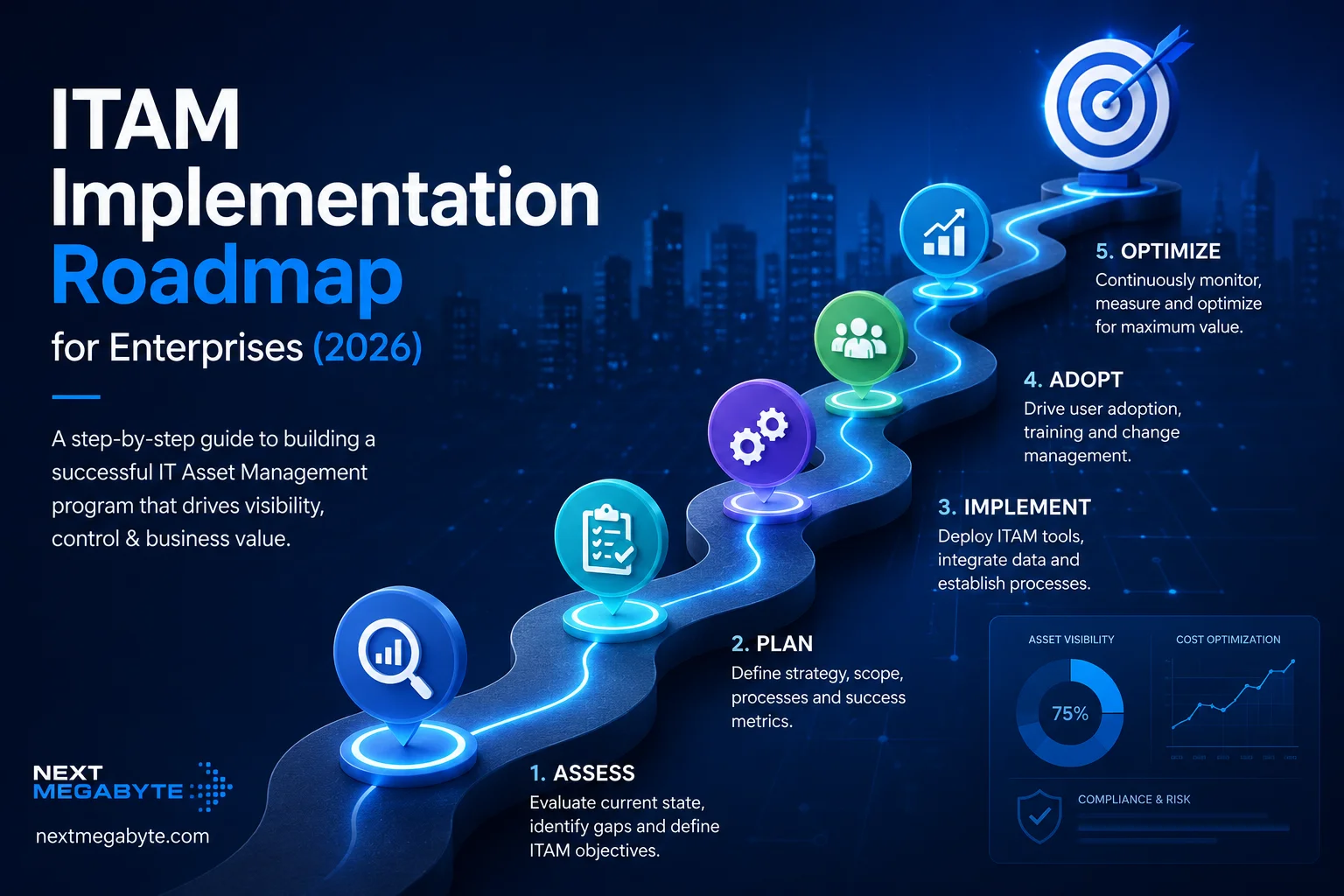
The roadmap below is structured across six strategic phases, each with clear objectives, success criteria, and interconnected outcomes.
Phase 1: Assess, Align, and Establish the Business Case
Every successful ITAM implementation begins with an honest baseline assessment — not a sales pitch, but a clear-eyed look at where the organization currently stands.
What to do in Phase 1:
- Conduct a current-state audit of all asset management practices, tools, and data sources (spreadsheets, CMDBs, procurement records, discovery tools)
- Identify the primary pain points driving the ITAM initiative — is it cost overruns, compliance exposure, security blind spots, or all three?
- Quantify the business case with hard numbers: unused license costs, hardware refresh cycles, audit penalty exposure, and IT helpdesk inefficiencies tied to asset gaps
- Align ITAM objectives with organizational priorities — cost optimization, cyber resilience, regulatory compliance (SOX, NIS2, DORA, GDPR), or ESG reporting
- Identify executive stakeholders across IT, finance, legal, and security who must support the program
Why this phase matters: ITAM initiatives that skip formal business case development tend to stall at the pilot stage. When IT leadership can show the CFO that the organization is carrying 15–20% of its software budget in unused or over-licensed tools, implementation funding follows quickly. This phase is also where you establish governance accountability — who owns the program, who owns the data, and who is responsible for lifecycle decisions.
Phase 1 Success Criteria: A documented ITAM maturity baseline (scored on key dimensions: Hardware Asset Management, Software Asset Management, cloud/SaaS visibility), a formal business case with projected ROI, and an executive sponsor commitment.
Phase 2: Define Scope, Governance, and ITAM Policy
With a validated business case in hand, Phase 2 is about building the structural foundation that will support the entire ITAM program — the governance model, the policy framework, and the technology scope.
What to do in Phase 2:
- Define the scope of assets to be managed: on-premises hardware, endpoint devices, data center equipment, licensed software, cloud workloads, SaaS subscriptions, and — increasingly in 2026 — IoT and OT devices
- Establish an ITAM governance framework: assign a dedicated ITAM manager or team, define data ownership policies, and document escalation paths for asset exceptions
- Create a formal IT Asset Management policy that covers asset acquisition, tagging standards, lifecycle stages, disposal protocols, and compliance obligations
- Define integration requirements with existing systems — ITSM platforms (ServiceNow, Jira), procurement systems, HR onboarding/offboarding workflows, and security tooling (SIEM, vulnerability management)
- Choose between building an internal ITAM capability, engaging a managed ITAM service provider, or a hybrid model
Why this phase matters: Without governance, even the best ITAM software becomes an expensive data dump. The policy framework establishes the rules of engagement — how assets are approved, tracked, transferred, and retired. In regulated industries, this documentation is also essential for demonstrating due diligence during audits. Organizations operating under NIS2 or DORA mandates, for example, are required to maintain accurate, up-to-date asset inventories as a compliance control — not just a best practice.
Phase 2 Success Criteria: A published ITAM policy document, a defined governance structure with named owners, a finalized asset scope, and documented integration requirements.
Phase 3: Tool Selection and IT Asset Management Software Deployment
Selecting the right ITAM software is one of the most consequential decisions in the implementation process. The enterprise ITAM software market in 2026 is mature and highly competitive, with solutions ranging from standalone asset tracking platforms to fully integrated ITSM suites.
Core capabilities to require from any enterprise ITAM platform:
- Automated asset discovery across on-premises, hybrid, multi-cloud, and SaaS environments — agent-based, agentless, and API-driven
- Normalized hardware and software catalog that classifies discovered assets consistently, eliminating duplicates and gaps
- Software License Management (SAM) with entitlement tracking, compliance position reporting, and renewal alerting
- Full lifecycle tracking from procurement and deployment through maintenance and retirement
- Real-time dashboards and reporting tailored to different stakeholders — IT operations, finance, security, and executive leadership
- Integration connectors for ITSM, security tools (SIEM, EDR), procurement, HR systems, and FinOps platforms
- Low-code automation for lifecycle workflows: onboarding provisioning, offboarding recovery, approval chains, and disposal processing
On the question of build vs. buy: In 2026, nearly all enterprise ITAM programs are built on purpose-built platforms. Spreadsheet-based approaches cannot scale beyond a few hundred assets without becoming a liability — they introduce manual error, lack version control, and cannot integrate with other enterprise systems. Platforms such as those built around the nextmegabyte.com ecosystem are designed specifically to address this complexity at enterprise scale, providing unified visibility across hardware, software, and cloud assets without the configuration overhead of legacy ITSM-first tools.
What to avoid: Selecting a tool based solely on feature lists rather than implementation complexity. Enterprise ITAM deployments require robust data migration plans, user training programs, and clear rollback procedures. Pilot the tool with a defined subset of assets (one business unit or asset category) before enterprise-wide rollout.
Phase 3 Success Criteria: ITAM platform deployed in a pilot environment, initial asset discovery completed for pilot scope, data quality baseline established, and integration with at least one adjacent system (ITSM or procurement) validated.
Phase 4: Asset Discovery, Inventory Build, and Data Normalization
This is the operational heart of the ITAM implementation — and frequently the phase where organizations discover just how large the visibility gap actually is. Full asset discovery across a mid-to-large enterprise routinely surfaces 20–40% more assets than IT teams estimated, including forgotten endpoints, shadow IT tools, and cloud resources with no owner.
The IT Asset Lifecycle Framework (implemented in Phase 4):
ITAM operates across a structured lifecycle. Each stage generates data that feeds compliance reporting, cost optimization, and security posture management.Asset Lifecycle=Plan→Procure→Deploy→Monitor→Maintain→Retire
- Plan: Define asset requirements based on business need, budget, and refresh schedules. Ensure new asset requests are approved and recorded before procurement.
- Procure: Purchase assets through approved channels with full contract, warranty, and license entitlement data captured at point of acquisition.
- Deploy: Assign assets to users, departments, or infrastructure. Tag physical assets (barcode/RFID/QR), configure software assets with license keys and compliance parameters.
- Monitor: Track asset utilization, health status, software version compliance, and warranty expiry in real time. Flag deviations — idle hardware, unused software seats, unlicensed installations.
- Maintain: Manage patches, upgrades, warranty renewals, and hardware repairs within the ITAM system. Ensure all changes are recorded and auditable.
- Retire: Follow formal decommissioning procedures — data sanitization for hardware, license reclamation for software, and certified ITAD (IT Asset Disposition) vendor engagement for responsible disposal. For enterprises with CSRD obligations, this stage generates the ESG data needed for sustainability reporting.
Data normalization is non-negotiable. Raw discovery data from enterprise environments is typically messy — inconsistent naming conventions, duplicate entries, missing owner fields, and unclassified software. Invest time in normalization before expanding scope. Data quality at this stage directly determines the reliability of every compliance report, cost analysis, and security assessment that ITAM will produce going forward.
Phase 4 Success Criteria: Normalized asset inventory covering ≥90% of in-scope assets, lifecycle stage assigned to each asset, and data freshness policy established (automated refresh intervals defined per asset category).
Phase 5: Integration, Automation, and Cross-Functional Activation
A functioning ITAM database that sits in isolation delivers a fraction of its potential value. Phase 5 is where the ITAM program becomes an enterprise capability rather than an IT-only initiative — feeding real-time asset data into the workflows that depend on it.
Key integration workstreams:
- ITAM ↔ Security: Feed asset inventory, lifecycle stage, and software version data into vulnerability management platforms, SIEM, and EDR tools. When security teams know exactly which devices are running which software versions — and which have gone past end-of-life — they can prioritize remediation with precision. This directly addresses the finding that 74% of security incidents involve unmanaged assets.
- ITAM ↔ FinOps and Procurement: Integrate license entitlement data with actual usage metrics to identify over-licensed software. Connect procurement workflows so every purchase automatically generates an asset record. This is where software license optimization typically delivers its most visible ROI — organizations consistently recover 15–30% of software spend through systematic license reclamation in the first year after ITAM maturity improves.
- ITAM ↔ HR and ITSM: Automate device provisioning for new hires and asset recovery for offboarding employees. Connect with the service desk so hardware failures, software requests, and configuration changes automatically update asset records. This closes the “offboarding gap” — one of the most common and costly ITAM failures, where devices and licenses remain active for departed employees for months.
- ITAM ↔ ESG and Sustainability Reporting: For enterprises subject to CSRD or voluntary sustainability frameworks, connect disposal and lifecycle data to ESG reporting platforms. Document device refresh rates, refurbishment programs, and certified recycling volumes.
Automation priorities in 2026: AI-augmented ITAM platforms can now automate data anomaly detection, flag license compliance drift in real time, predict hardware failure based on age and utilization patterns, and surface unused SaaS subscriptions for reclamation — without requiring manual review cycles. These capabilities move ITAM from reactive record-keeping to proactive intelligence.
Phase 5 Success Criteria: Live integrations with ITSM, security tooling, and procurement; automated onboarding/offboarding asset workflows operational; first software license optimization report generated with quantified savings identified.
Phase 6: Continuous Improvement, KPI Tracking, and ITAM Maturity Advancement
ITAM is not a project with an end date — it is a continuous discipline. Phase 6 establishes the operating cadence that sustains and advances the program after initial implementation.
ITAM KPIs every enterprise should track:
- Inventory accuracy rate: Percentage of physical assets matching ITAM records (target: ≥95%)
- Software compliance position: Ratio of licensed entitlements to actual installations, by vendor (target: 100% compliant with zero unintentional over-deployment)
- License utilization rate: Percentage of purchased software seats actively used (target: ≥80%; anything below 60% indicates reclamation opportunity)
- Asset lifecycle adherence: Percentage of assets following the documented lifecycle process end-to-end (target: ≥90%)
- Mean time to provision: Average time from asset request to deployment (track and reduce over time)
- Audit readiness score: Ability to produce a complete, accurate asset inventory on demand (target: on-demand generation within 24 hours)
Governance cadences to maintain:
- Monthly ITAM operations review (data quality, compliance position, open exceptions)
- Quarterly stakeholder reporting to IT leadership, finance, and security (cost savings, risk reduction, program health)
- Annual ITAM maturity assessment to identify gaps, plan tooling upgrades, and adjust program scope for new asset categories (cloud, IoT, SaaS expansion)
The maturity progression: Most enterprises begin ITAM at a reactive, manual level and progress through defined maturity stages — from basic inventory tracking, to proactive lifecycle management, to AI-augmented intelligence and cross-functional strategic contribution. The roadmap above is designed to accelerate that progression in a structured, risk-managed way.
Common Pitfalls That Derail Enterprise ITAM Programs
Even well-funded ITAM programs stumble. Understanding the most common failure modes is as valuable as the roadmap itself.
- Treating ITAM as a one-time project rather than a continuous discipline — leading to data decay that makes the system unreliable within 12–18 months
- Underestimating data normalization effort — raw discovery data from enterprise environments requires significant cleansing before it is actionable
- Siloing ITAM within IT — failing to activate the value that comes from integrating asset data with security, finance, and HR creates an expensive inventory system with limited strategic impact
- Over-scoping the initial deployment — attempting to manage all asset categories simultaneously before the governance model and data quality are proven
- Neglecting SaaS and cloud assets — in 2026, SaaS sprawl and multi-cloud environments represent the fastest-growing category of unmanaged spend; any ITAM program that focuses only on on-premises hardware is already behind
- No executive sponsorship — ITAM requires cross-functional cooperation that only senior leadership can mandate; without it, adoption stalls at the IT department boundary
ITAM vs. SAM: Understanding the Relationship
One of the most frequent points of confusion in enterprise IT governance is the relationship between ITAM and Software Asset Management (SAM). They are related but distinct disciplines.
| Dimension | ITAM | SAM |
|---|---|---|
| Scope | All IT assets: hardware, software, cloud, SaaS, data | Software licenses and entitlements only |
| Primary goal | Full lifecycle governance across all asset types | License compliance and software cost optimization |
| Key stakeholders | IT, finance, security, procurement, HR | IT, legal, finance, vendor management |
| Core risk addressed | Asset visibility gaps, lifecycle waste, security exposure | Over-licensing, under-licensing, audit penalties |
| Relationship | SAM is a subset and component of a complete ITAM program | ITAM provides the infrastructure within which SAM operates |
In practice, most enterprises build SAM capability within their broader ITAM framework. A mature ITAM platform will include dedicated Software Asset Management tooling as an integrated module, rather than requiring a separate standalone system.
Who Should Lead the ITAM Implementation?
Enterprise ITAM implementations benefit from a clearly defined ownership model. The program is best led by a dedicated ITAM Manager or IT Asset Manager reporting to the CIO or VP of IT Operations, with formal stakeholder representation from:
- IT Operations (tool deployment, asset discovery, helpdesk integration)
- IT Security (vulnerability management, incident response integration)
- Finance and Procurement (license cost tracking, hardware budgeting, vendor contracts)
- Legal and Compliance (license agreement obligations, regulatory asset inventory requirements)
- HR (onboarding/offboarding workflows, role-based provisioning policies)
In organizations without dedicated ITAM resources, a managed ITAM service engagement — where an external partner runs the program operationally while internal IT retains governance oversight — can compress the time to value significantly.
FAQ: IT Asset Management Implementation
What is IT Asset Management (ITAM)? IT Asset Management is the practice of systematically tracking, governing, and optimizing an organization’s technology assets — hardware, software, cloud resources, and SaaS tools — across their full lifecycle, from procurement through retirement. The goal is maximum asset value, cost efficiency, license compliance, and security posture.
How long does ITAM implementation take for a large enterprise? A phased enterprise ITAM implementation typically spans 9–18 months to reach a mature, integrated state. The first phase (assessment and business case) can be completed in 4–6 weeks. Initial asset discovery and a working ITAM platform can be operational within 3–4 months. Full cross-functional integration and continuous improvement cadences generally stabilize within the first year.
What is the ROI of implementing ITAM? Organizations with mature ITAM programs consistently report 15–30% reductions in software spend through license optimization, 8–15% reductions in annual hardware operational expenditure, and 40–60% reductions in audit preparation time. Security benefits — while harder to quantify directly — include measurable reduction in attack surface exposure from previously unmanaged assets.
What is the difference between ITAM and SAM? ITAM (IT Asset Management) is the broader discipline covering all technology assets across their lifecycle. SAM (Software Asset Management) is a specific component of ITAM focused exclusively on software license governance, compliance position management, and software cost optimization.
What are the biggest risks of operating without ITAM? The primary risks include: financial waste from unused or duplicated software licenses; compliance exposure and potential penalties from vendor audits; security vulnerabilities from unmanaged, unpatched, or unknown assets; operational inefficiency from untracked hardware; and inability to provide accurate asset data for regulatory reporting (SOX, NIS2, GDPR, CSRD).
What types of assets does ITAM cover? A complete enterprise ITAM program covers hardware assets (laptops, servers, networking equipment, mobile devices), software assets (on-premises licenses, SaaS subscriptions, open-source software), cloud assets (IaaS/PaaS resources, cloud-native workloads), and increasingly in 2026, IoT and OT devices connected to the corporate network.
Does ITAM require a dedicated software platform? For any organization managing more than a few hundred assets, yes. Spreadsheet-based asset tracking cannot provide the automated discovery, real-time monitoring, compliance position reporting, and cross-system integration required for enterprise-grade ITAM. Purpose-built ITAM software is the foundation of any scalable program.
How does ITAM support cybersecurity? ITAM supports cybersecurity by maintaining a real-time, accurate inventory of all assets — including their software versions, patch status, lifecycle stage, and ownership. This enables security teams to identify unmanaged devices, prioritize patch remediation, detect shadow IT, and respond faster to incidents by understanding exactly what assets were involved.
Conclusion: ITAM as a Strategic Enterprise Capability
The enterprises that will extract the most value from their technology investments in 2026 and beyond are not necessarily those spending the most on IT — they are the ones who know exactly what they have, what it costs, and what risk it carries. That is what a mature ITAM program delivers.
The roadmap outlined here — from baseline assessment and governance design through tool deployment, asset discovery, cross-functional integration, and continuous improvement — is not a theoretical framework. It reflects the operational reality of how successful enterprise ITAM programs are built. The sequencing matters. Governance before tooling, data quality before automation, pilot scope before enterprise rollout.
For CIOs and IT leaders, the implementation question in 2026 is not whether ITAM is worth the investment. The market data, the compliance landscape, and the security threat environment have answered that definitively. The question is how to execute it in a way that builds durable capability, demonstrates ROI early, and scales with the organization’s evolving technology estate.
Ready to Build Your ITAM Roadmap?
At nextmegabyte.com, we work with enterprise IT teams to design, implement, and optimize IT Asset Management programs that go beyond inventory — delivering measurable cost savings, compliance assurance, and security visibility from the first phase of deployment.
Whether you’re starting from scratch, consolidating fragmented asset tools, or preparing for a software audit, our team can help you build a roadmap tailored to your environment.
Explore our IT Asset Management solutions → | Request a Demo →
This article is published by nextmegabyte.com — an authority resource for enterprise IT operations, Software Asset Management, and IT lifecycle strategy.